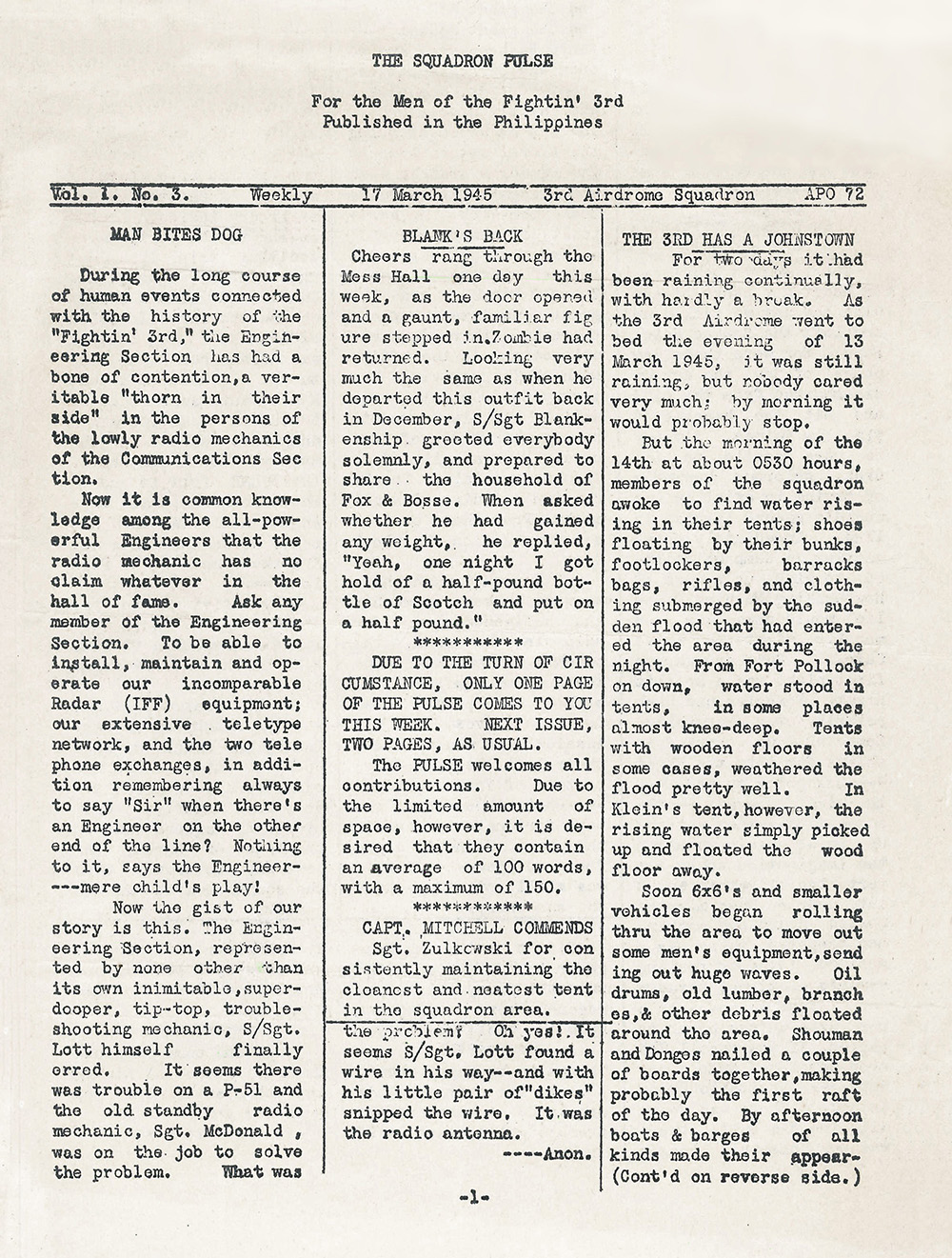
THE SQUADRON PULSE
For the Men of the Fightin’ 3rd
Published in the Philippines
Vol. 1. No. 3. Weekly 17 March 1945 3rd Airdrome Squadron APO 72
MAN BITES DOG
During the long course of human events connected with the history of the “Fightin’ 3rd,” the Engineering Section has had a bone of contention, a veritable “thorn in their side” in the persons of the lowly radio mechanics of the Communications Section.
Now it is common knowledge among the all-powerful Engineers that the radio mechanic has no claim whatever in the hall of fame. Ask any member of the Engineering Section. To be able to install, maintain and operate our incomparable Radar (IFF) equipment; our extensive teletype network, and the two telephone exchanges, in addition remembering always to say “Sir” when there’s an Engineer on the other end of the line? Nothing to it, says the Engineer----mere child’s play!
Now the gist of our story is this. The Engineering Section, represented by none other than its own inimitable, super-dooper, tip-top, troubleshooting mechanic, S/Sgt. Lott himself erred. It seems there was trouble on a P-51 and the old standby radio mechanic, Sgt. McDonald, was on the job to solve the problem. What was the problem? Oh yes! It seems S/Sgt. Lott found a wire in his way--and with his little pair of “dikes” snipped the wire. It was the radio antenna.
----Anon.
BLANK’S BACK
Cheers rang through the Mess Hall one day this week, as the door opened and a gaunt, familiar figure stepped in. Zombie had returned. Looking very much the same as when he departed this outfit back in December, S/Sgt Blankenship greeted everybody solemnly, and prepared to share the household of Fox & Bosse. When asked whether he had gained any weight, he replied, “Yeah, one night I got hold of a half-pound bottle of Scotch and put on a half pound.”
DUE TO THE TURN OF CIRCUMSTANCE, ONLY ONE PAGE OF THE PULSE COMES TO YOU THIS WEEK. NEXT ISSUE, TWO PAGES, AS USUAL. [By "one page" he means one sheet of paper, or two pages. - Ed.]
The PULSE welcomes all contributions. Due to the limited amount of space, however, it is desired that they contain an average of 100 words, with a maximum of 150.
CAPT. MITCHELL COMMENDS
Sgt. Zulkowski for consistently maintaining the cleanest and neatest tent in the squadron area.
THE 3RD HAS A JOHNSTOWN
For two days it had been raining continually, with hardly a break. As the 3rd Airdrome went to bed the evening of 13 March 1945, it was still raining, but nobody cared very much; by morning it would probably stop.
But the morning of the 14th at about 0530 hours, members of the squadron awoke to find water rising in their tents; shoes floating by their bunks, footlockers, barracks bags, rifles, and clothing submerged by the sudden flood that had entered the area during the night. From Fort Pollock on down, water stood in tents, in some places almost knee-deep. [Fort Pollock refers to the latrine, named in honor of the squadron's doctor, Captain R.W. Pollock. - Ed.] Tents with wooden floors in some cases, weathered the flood pretty well. In Klein’s tent, however, the rising water simply picked up and floated the wood floor away.
Soon 6x6’s and smaller vehicles began rolling thru the area to move out some men’s equipment, sending out huge waves. Oil drums, old lumber, branches, & other debris floated around the area. Shouman and Donges nailed a couple of boards together, making probably the first raft of the day. By afternoon boats & barges of all kinds made their appearance, running a sort of Taxi Service.
Other sidelights: Tindell on the sack, watching the water flow by, reached out, picked up a passing carton of Chesterfields, still dry inside.
Going to the fort was an exciting trip thru unknown waters, until Lt. Cantor engineered a bridge across the banks. In McDonald’s tent, a huge lobster was discovered and captured. The area around Mac’s tent, surrounded by invisible foxholes, was a dangerous place for the unwary. Both editors of the PULSE fell in one of Mac’s foxholes while trying to navigate thru his tent. Worse than this was Hritsko’s mishap--he fell in a well.
Only individual to stay dry during the whole business: Aquaphobia victim, R.T. Smith, who never got his feet damp.
The cause of it all was the nearby river, swollen by the rains & held up by the tide. Would the water rise even more? Nobody knew exactly, but, everybody agreed that on the 14th of March, the best way to travel thru the squadron was on a raft.
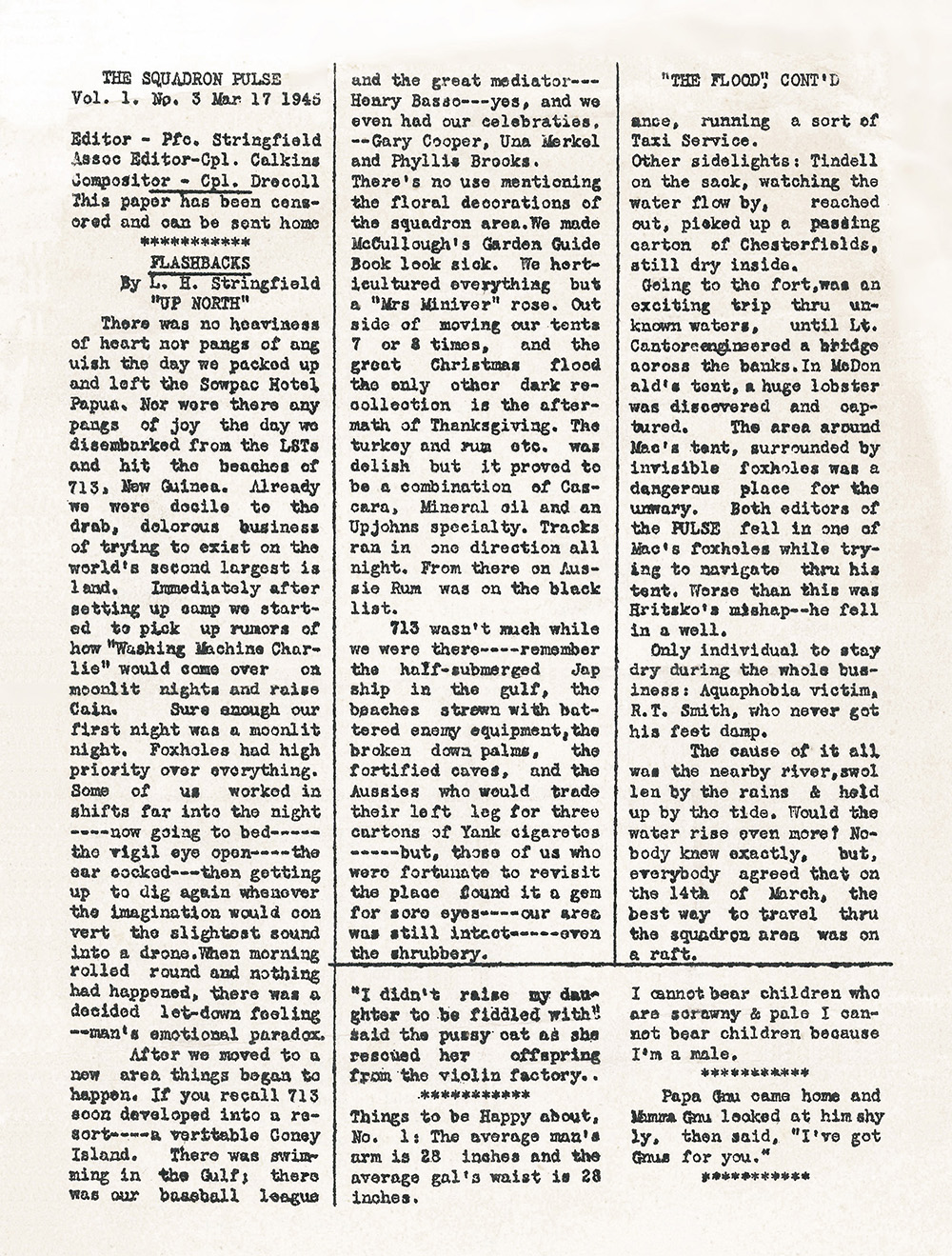
THE SQUADRON PULSE
Vol. 1. No. 3 Mar 17 1945
Editor - Pfc. Stringfield
Assoc Editor - Cpl. Calkins
Compositor - Cpl. Drecoll
This paper has been censored and can be sent home
FLASHBACKS
By L.H. Stringfield
“UP NORTH”
There was no heaviness of heart nor pangs of anguish the day we packed up and left the Sowpac Hotel Papua [SOWPAC is the Southwestern Pacific Command - Ed.]. Nor were there any pangs of joy the day we disembarked from the LSTs and hit the beaches of [APO] 713, New Guinea. Already we were docile to the drab, dolorous business of trying to exist on the world’s second largest island. Immediately after setting up camp we started to pick up rumors of how “Washing Machine Charlie” would come over on moonlit nights and raise Cain. Sure enough our first night was a moonlit night. Foxholes had high priority over everything. Some of us worked in shifts far into the night----now going to bed----the vigil [vigilant?] eye open----the ear cocked---then getting up to dig again whenever the imagination would convert the slightest sound into a drone. When morning rolled round and nothing had happened, there was a decided let-down feeling--man’s emotional paradox.
After we moved to a new area, things began to happen. If you recall, 713 soon developed into a resort----a veritable Coney Island. There was swimming in the Gulf; there was our baseball league and the great mediator---Henry Basso---yes, and we even had our celebrities--Gary Cooper, Una Merkel and Phyllis Brooks.
There’s no use mentioning the floral decorations of the squadron area. We made McCullough’s Garden Guide Book look sick. [The McCullough Seed Company used to publish a series of books called McCullough’s Seed Catalogue and Amateur’s Guide. - Ed.] We horticultured everything but a “Mrs. Miniver” rose. Outside of moving tents 7 or 8 times, and the great Christmas flood, the only other dark recollection is the aftermath of Thanksgiving. The turkey and rum etc. was delish, but it proved to be a combination of Cascara, mineral oil and an Upjohns specialty. Tracks ran in one direction all night. From there on Aussie rum was on the black list.
713 wasn’t much while we were there----remember the half-submerged Jap ship in the gulf, the beaches strewn with battered enemy equipment, the broken down palms, the fortified caves, and the Aussies who would trade their left leg for three cartons of Yank cigarettes----but, those of us who were fortunate to revisit the place found it gem for sore eyes----our area was still intact----even the shrubbery.
“I didn’t raise my daughter to be fiddled with!” said the pussy cat as she rescued her offspring from the violin factory…
Things to be Happy about, No. 1: The average man’s arm is 28 inches and the average gal’s waist is 28 inches.
I cannot bear children who are scrawny & pale. I cannot bear children because I’m a male.
Papa Gnu came home and Mamma Gnu looked at him shyly, then said, “I’ve got Gnus for you.”
|
|